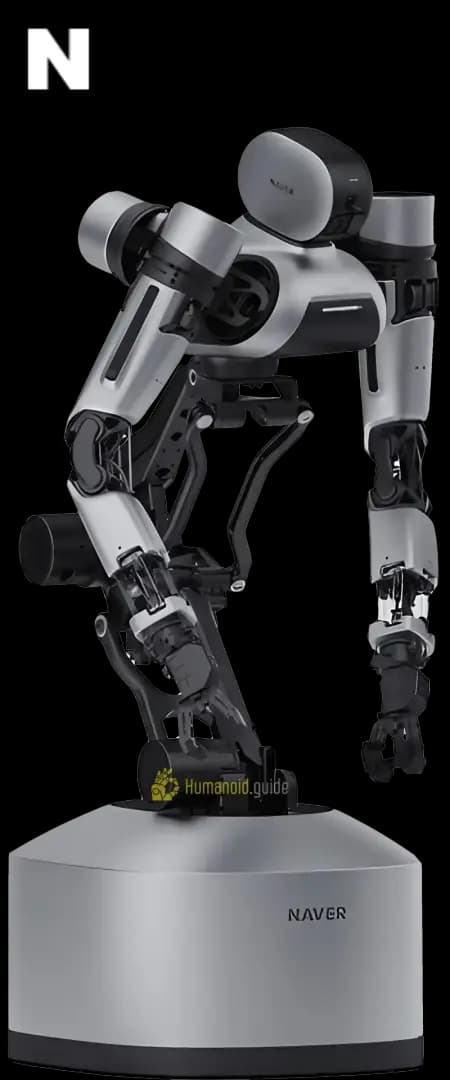
Ambidex
Cable-driven dual-arm robot for safe human interaction
Price
Price not publicly disclosed
Record checked Jul 6, 2026
Key facts
Values reflect the public record
- Height
- No public data documented
- Weight
- 2.6 kg per armManufacturer confirmed
- Payload
- 3 kg per armManufacturer confirmed
- Degrees of freedom
- 14 (7 per arm)Manufacturer confirmed
- Runtime
- No public data documented
- Max speed
- 5 m/sManufacturer confirmed
Canonical robot record
Overview
Ambidex is a dual-arm robot from NAVER LABS, the R&D subsidiary of South Korea's NAVER, created through a long-term research collaboration with KOREATECH and Professor Yong-Jae Kim. Its defining feature is an innovative cable-driven power-transmission mechanism that lets each arm stay exceptionally light while remaining strong and stable, so the robot can move quickly yet interact gently and safely with people.
NAVER LABS positions Ambidex as research toward robot arms suited to home and collaborative settings, where machines must share space with humans rather than operate behind safety cages. The robot was recognized in the robotics and drones category of the CES 2019 Innovation Awards.
Beyond the hardware, NAVER LABS has used Ambidex as a platform for networked and learning-based control. With Qualcomm it demonstrated 5G-connected ('brainless') teleoperation in which heavy computation runs off-board, and it has built environments for haptic-device-based task learning from human demonstration.
RoboZaps maintains this record as part of its canonical robotics database. Specs are source-verified where linked; the record compares public facts across manufacturers rather than representing a single robot maker.
- Spec sources
- 2 linked
- Verification
- Verified · 5/5 specs source-verified
- Deployment
- Announced
- Last verified
- Jul 6, 2026
Key Features
- Cable-driven power-transmission mechanism that delivers strength and stability while keeping each arm very light
- Designed for safe, natural physical interaction with humans in collaborative and home environments
- Demonstrated 5G-based remote ('brainless') control with off-board computation
- Used as a research platform for task learning from human force and haptic demonstration
- Recognized in the robotics and drones category at the CES 2019 Innovation Awards
Specifications
Grouped technical data with source detail available on demand.
5 documented values
Mechanics
| Degrees of Freedom | 14 (7 per arm)Manufacturer confirmedVerified Jul 6, 2026 NAVER LABS (opens in a new tab) |
|---|---|
| Locomotion | StationaryManufacturer confirmedVerified Jul 6, 2026 NAVER LABS (opens in a new tab) |
Performance
| Max Speed | 5 m/sManufacturer confirmedVerified Jul 6, 2026 NAVER LABS (opens in a new tab) |
|---|---|
| Payload Capacity | 3 kg per armManufacturer confirmedVerified Jul 6, 2026 NAVER LABS (opens in a new tab) |
Physical
| Weight | 2.6 kg per armManufacturer confirmedVerified Jul 6, 2026 NAVER LABS (opens in a new tab) |
|---|
Evidence & changelog
Sources behind this record and material corrections made over time.
Sources
- NAVER LABS - tranche-2 verification (opens in a new tab) · NAVER LABS — cites Weight, Degrees of Freedom, Payload Capacity, Max Speed
- NAVER LABS - tranche-2 verification (opens in a new tab) · NAVER LABS — cites Locomotion
Media
Manufacturer
NAVER's R&D subsidiary developing robotic arms and AI-driven autonomous systems.
- Headquarters
- Seongnam, South Korea
- Founded
- 2017