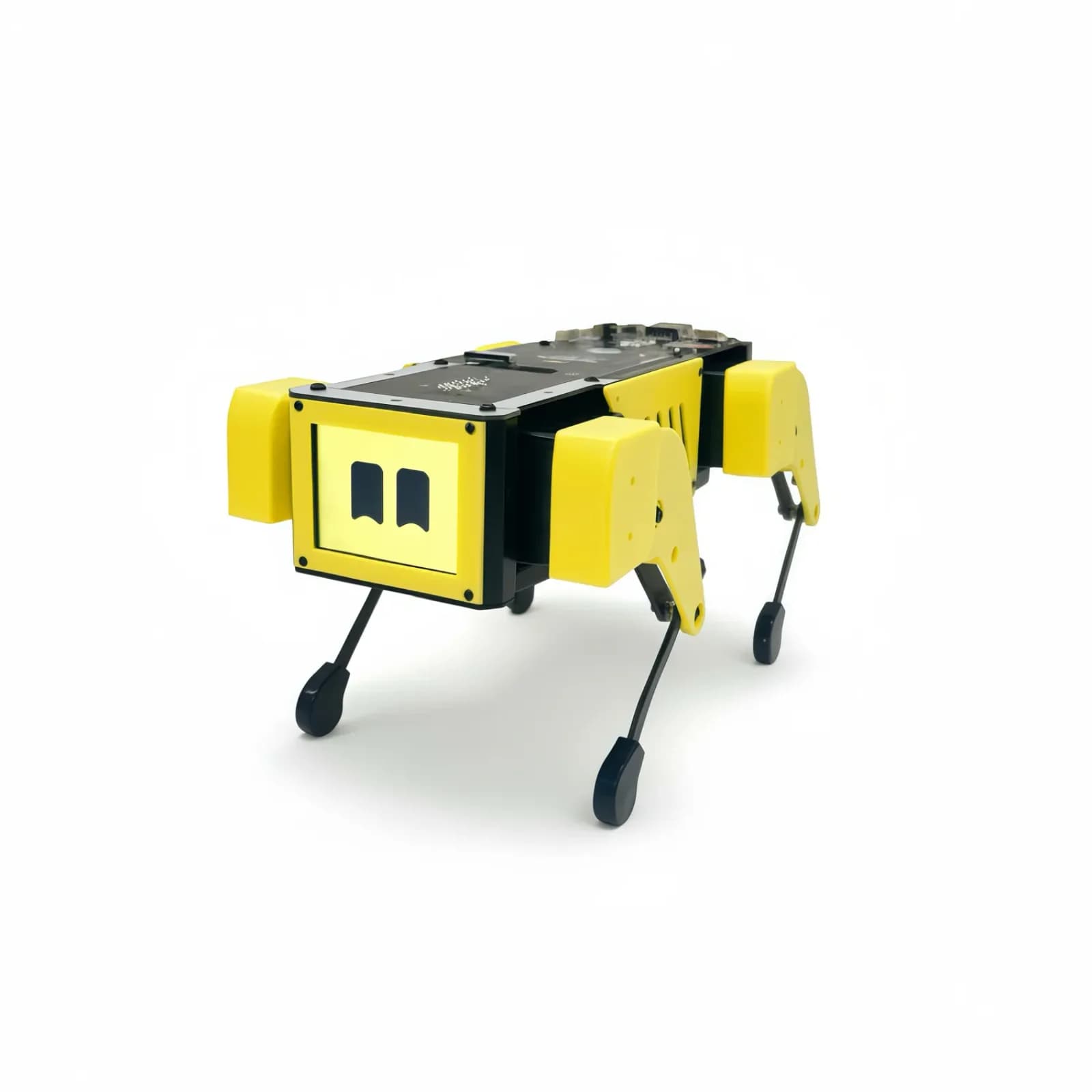
Mini Pupper 2
Open-source ROS robot dog kit
Price
$649
Legacy record price · Jul 9, 2026
Key facts
Values reflect the public record
- Height
- 165 mm (Raspberry Pi 4 version; CM4 version 140 mm)Third-party source
- Weight
- 0.45 kgThird-party source
- Payload
- No public data documented
- Degrees of freedom
- 12Third-party source
- Runtime
- ~30-50 min (built-in 1,000 mAh battery, high-load use; external power adapter supported)Third-party source
- Max speed
- No public data documented
Canonical robot record
Overview
Mini Pupper 2 is an open-source quadruped robot dog kit from MangDang, a robotics company founded in 2020 and based in Hong Kong. It builds on the company's original Mini Pupper, aiming to make hands-on robotics accessible to students, educators, and hobbyists at an approachable price point.
The robot is powered by a Raspberry Pi compute platform and runs ROS2, letting users explore SLAM, navigation, kinematics, and computer vision with ready-to-use examples. It also integrates with generative-AI tools such as ChatGPT, Gemini, and Claude, positioning it as a flexible learning and experimentation platform.
Sold through MangDang's official store in multiple assembly configurations, including pre-assembled and DIY upgrade kits, Mini Pupper 2 is marketed as quick to set up and highly expandable, with optional add-ons such as a Raspberry Pi camera module for vision projects.
RoboZaps maintains this record as part of its canonical robotics database. Specs are source-verified where linked; the record compares public facts across manufacturers rather than representing a single robot maker.
- Spec sources
- 3 linked
- Verification
- Partially verified · 9/10 specs source-verified
- Deployment
- Paid Deployment
- Last verified
- Jul 9, 2026
Key Features
- Open-source hardware and software designed for customization and community contribution
- Runs ROS2 with ready-to-use SLAM and navigation examples
- Raspberry Pi-powered controller for high expandability
- Supports computer vision with single and 3D camera options
- Integrates with generative-AI assistants including ChatGPT, Gemini, and Claude
- Available in multiple assembly configurations, from pre-assembled kits to DIY upgrade kits
Specifications
Grouped technical data with source detail available on demand.
10 documented values
Connectivity
| Communication | WiFi, BluetoothThird-party sourceVerified Jul 9, 2026 CNX Software |
|---|
Mechanics
| Degrees of Freedom | 12Third-party sourceVerified Jul 9, 2026 CNX Software |
|---|---|
| Locomotion | QuadrupedManufacturer confirmedVerified Jul 9, 2026 MangDang |
Physical
| Height | 165 mm (Raspberry Pi 4 version; CM4 version 140 mm)Third-party sourceVerified Jul 9, 2026 CNX Software |
|---|---|
| Weight | 0.45 kgThird-party sourceVerified Jul 9, 2026 CNX Software |
Power
| Runtime | ~30-50 min (built-in 1,000 mAh battery, high-load use; external power adapter supported)Third-party sourceVerified Jul 9, 2026 Mia (pet-robot review) |
|---|
Sensing
| Sensors | IMU, optional LiDAR and cameraThird-party sourceVerified Jul 9, 2026 CNX Software |
|---|
Software
| ROS Compatible | YesManufacturer confirmedVerified Jul 9, 2026 MangDang |
|---|---|
| SDK Support | YesManufacturer confirmedVerified Jul 9, 2026 MangDang |
| Controller | Raspberry Pi Unverified |
Evidence & changelog
Sources behind this record and material corrections made over time.
Sources
- CNX Software — cites Height, Sensors, Communication, Degrees of Freedom, Weight
- MangDang — cites Locomotion, SDK Support, ROS Compatible
- Mia (pet-robot review) — cites Battery Life
Media
Manufacturer
Developer of open-source quadruped robots and AI-powered robotic platforms for education and research applications.
- Headquarters
- Hong Kong
- Founded
- 2020