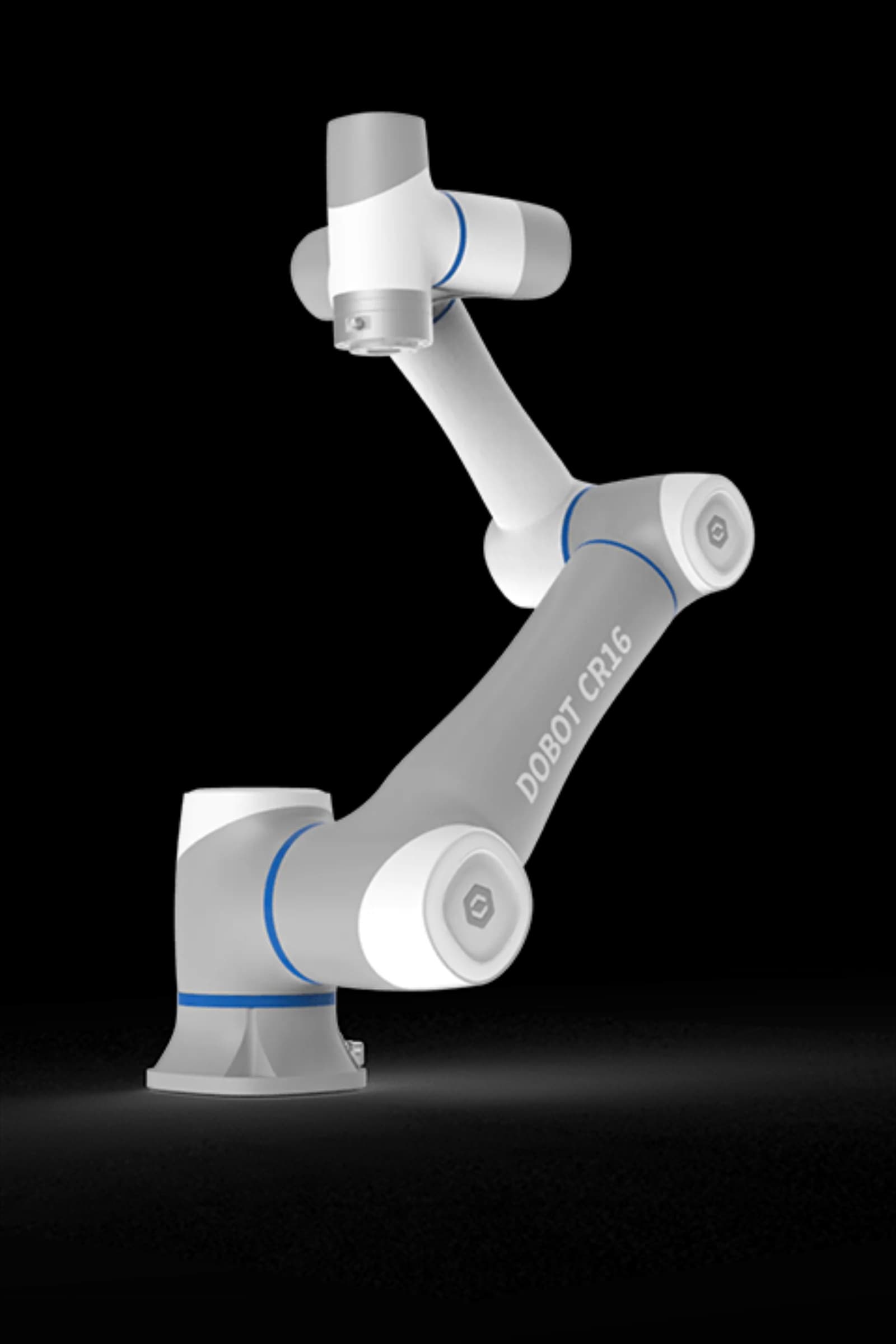
DOBOT CR16
6-axis 16 kg-payload collaborative robot arm
Price
$27,000 – $36,000
Legacy record price · Jul 10, 2026
Key facts
Values reflect the public record
- Height
- No public data documented
- Weight
- 40 kg (per current official brochure; older hardware guide says 37 kg, CR16 V2 hardware 43.5 kg)Manufacturer confirmed
- Payload
- 16 kgManufacturer confirmed
- Degrees of freedom
- 6Manufacturer confirmed
- Runtime
- No public data documented
- Max speed
- 3 m/s (3,000 mm/s)Manufacturer confirmed
Canonical robot record
Overview
The Dobot CR16 is a six-axis collaborative robot arm within Dobot's CR (CRA) series, aimed at handling heavier objects and improving the efficiency of tasks such as palletizing. Dobot describes the series as built around high-performance integrated joints that deliver a meaningful improvement in cycle time alongside stable, accurate motion.
As a collaborative robot, the CR16 is designed to operate safely alongside human workers, with multiple built-in safety functions and certification to established collaborative-robot safety standards. Dobot markets it for a broad range of sectors including automotive, consumer electronics, semiconductor, healthcare, chemical, and retail.
The arm is intended to be flexible and simple to deploy, and is compatible with Dobot's wider ecosystem of plug-and-play accessories and software tooling, lowering the barrier to integrating it into existing production or research workflows.
RoboZaps maintains this record as part of its canonical robotics database. Specs are source-verified where linked; the record compares public facts across manufacturers rather than representing a single robot maker.
- Spec sources
- 2 linked
- Verification
- Verified · 15/15 specs source-verified
- Deployment
- Scaled Deployment
- Last verified
- Jul 10, 2026
Key Features
- High-performance integrated joints for faster, more efficient cycle times
- Designed for safe human-robot collaboration with multiple built-in safety functions
- Suited to heavier handling and palletizing-style tasks across many industries
- Compatible with Dobot's plug-and-play accessory and software ecosystem for easy deployment
Specifications
Grouped technical data with source detail available on demand.
15 documented values
Connectivity
| Communication | TCP/IP, Modbus TCP, WiFiManufacturer confirmedVerified Jul 9, 2026 Dobot (official CR Series brochure D230308, distributor-hosted) |
|---|---|
| Tool I/O | 2 DI, 2 DO, 2 AI, RS-485 (Modbus-RTU) at the flange; 24 V tool power @ 1 A (2 A for <1 s); ISO 9409-1 flangeManufacturer confirmedVerified Jul 13, 2026 Dobot |
Environment
| IP Rating | IP54Manufacturer confirmedVerified Jul 9, 2026 Dobot (official CR Series brochure D230308, distributor-hosted) |
|---|---|
| Operating Temperature | 0–45 °CManufacturer confirmedVerified Jul 13, 2026 Dobot |
Mechanics
| Degrees of Freedom | 6Manufacturer confirmedVerified Jul 9, 2026 Dobot (official CR Series brochure D230308, distributor-hosted) |
|---|---|
| Locomotion | StationaryManufacturer confirmedVerified Jul 9, 2026 Dobot (official CR Series brochure D230308, distributor-hosted) |
Performance
| Max Speed | 3 m/s (3,000 mm/s)Manufacturer confirmedVerified Jul 9, 2026 Dobot (official CR Series brochure D230308, distributor-hosted) |
|---|---|
| Payload Capacity | 16 kgManufacturer confirmedVerified Jul 9, 2026 Dobot (official CR Series brochure D230308, distributor-hosted) |
| Reach | 1000 mm (working radius; max reach 1223 mm)Manufacturer confirmedVerified Jul 9, 2026 Dobot (official CR Series brochure D230308, distributor-hosted) |
| Repeatability | ±0.03 mmManufacturer confirmedVerified Jul 9, 2026 Dobot (official CR Series brochure D230308, distributor-hosted) |
Physical
| Weight | 40 kg (per current official brochure; older hardware guide says 37 kg, CR16 V2 hardware 43.5 kg)Manufacturer confirmedVerified Jul 9, 2026 Dobot (official CR Series brochure D230308, distributor-hosted) |
|---|
Power
| Power consumption | 350 W typical (8.4 A @ 48 V)Manufacturer confirmedVerified Jul 13, 2026 Dobot |
|---|---|
| Power supply | Robot DC 48 V; CC162 controller 110/220 V AC, 50/60 HzManufacturer confirmedVerified Jul 13, 2026 Dobot |
Safety
| Safety functions | 22 built-in safety features + collision detection (5 levels) + optional SafeSkin pre-collision; compliant with EN ISO 10218-1, ISO/TS 15066, ISO 13849-1, UL 1740, CSA Z434, NFPA 79 (no PL/Category stated for the CR series)Manufacturer confirmedVerified Jul 13, 2026 Dobot |
|---|
Software
| Controller | DOBOT CC162 control cabinet (48 V DC out, IP20); DobotStudio Pro (drag-to-teach, Blockly, Lua)Manufacturer confirmedVerified Jul 13, 2026 Dobot |
|---|
Evidence & changelog
Sources behind this record and material corrections made over time.
Sources
- Dobot (official CR Series brochure D230308, distributor-hosted) — cites Payload Capacity, Reach, Weight, Max Speed, Repeatability, Degrees of Freedom, IP Rating, Communication, Locomotion
- Dobot CR Series User Guide V1.5 · Dobot — cites Power supply, Power consumption, Tool I/O, Operating Temperature, Controller, Safety functions
Media
Manufacturer
Developer of affordable desktop and collaborative robotic arms for education and industrial automation.
- Headquarters
- Shenzhen, China
- Founded
- 2015