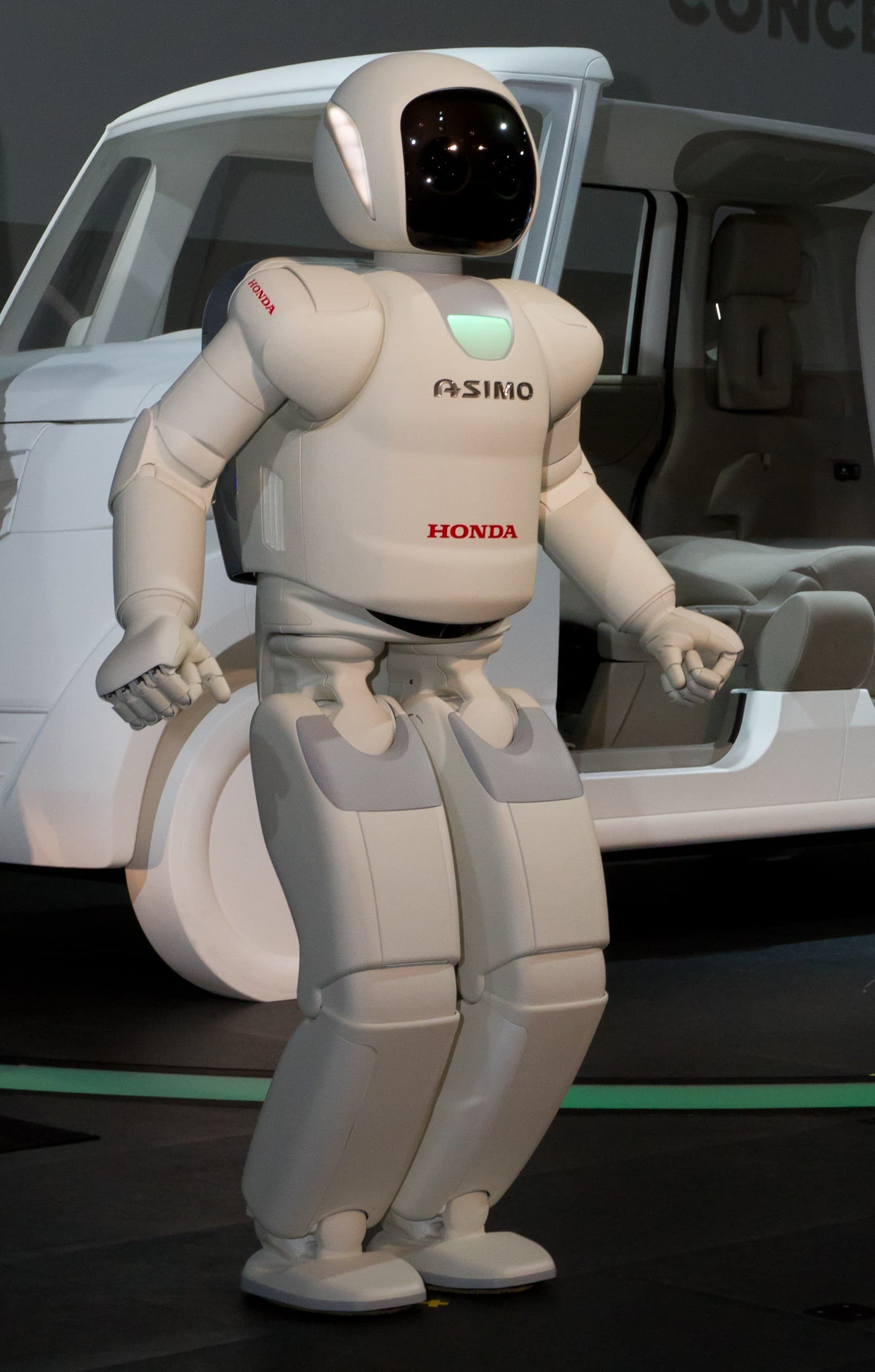
ASIMO
Honda's autonomous bipedal humanoid robot
Price
Historical record
No current purchase price is documented.
Key facts
Values reflect the public record
- Height
- 1300 mmManufacturer confirmed
- Weight
- 48 kgManufacturer confirmed
- Payload
- No public data documented
- Degrees of freedom
- 57Manufacturer confirmed
- Runtime
- 60 minManufacturer confirmed
- Max speed
- 9 km/h (2.5 m/s) running - 2011 modelManufacturer confirmed
Canonical robot record
Overview
ASIMO, short for Advanced Step in Innovative Mobility, was Honda's humanoid biped robot and the culmination of decades of Honda research into bipedal locomotion that began with its earlier P-series prototypes. First unveiled in 2000, ASIMO was conceived as a robot that could one day assist people within ordinary human living spaces, sized so it could reach light switches, doorknobs, and work at tables.
Unlike a typical product, ASIMO was developed as a research platform and public ambassador for Honda's robotics program. Successive generations added the ability to walk and run smoothly, climb and descend stairs, carry objects, recognize faces and voices, and ultimately behave autonomously by interpreting the movements and intentions of nearby people.
Honda has framed ASIMO as a concluded chapter of its robotics research, drawing lessons from more than two decades of demonstrations and shifting its focus toward non-bipedal mobility methods for future robots.
RoboZaps maintains this record as part of its canonical robotics database. Specs are source-verified where linked; the record compares public facts across manufacturers rather than representing a single robot maker.
- Spec sources
- 3 linked
- Verification
- Verified · 7/7 specs source-verified
- Deployment
- Discontinued
- Last verified
- Jul 8, 2026
Key Features
- Autonomous behavior control that lets it make decisions and act based on the movements of surrounding people
- Bipedal locomotion capable of walking, running, hopping on one or two legs, and climbing stairs
- Multi-fingered hands with tactile and force sensing for manipulating objects and performing gestures
- Face and voice recognition enabling natural interaction with people
- Highly articulated body with many independent degrees of freedom across head, arms, hands, torso, and legs
Specifications
Grouped technical data with source detail available on demand.
9 documented values
Mechanics
| Degrees of Freedom | 57Manufacturer confirmedVerified Jul 8, 2026 Honda Motor Co. (archived 2011 all-new ASIMO press release) |
|---|---|
| Locomotion | BipedalManufacturer confirmedVerified Jul 8, 2026 Honda Motor Co. (archived press release) |
Performance
| Max Speed | 9 km/h (2.5 m/s) running - 2011 modelManufacturer confirmedVerified Jul 8, 2026 Honda Motor Co. (archived 2011 all-new ASIMO press release) |
|---|
Physical
| Height | 1300 mmManufacturer confirmedVerified Jul 8, 2026 Honda Motor Co. (archived 2011 all-new ASIMO press release) |
|---|---|
| Weight | 48 kgManufacturer confirmedVerified Jul 8, 2026 Honda Motor Co. (archived 2011 all-new ASIMO press release) |
| Width | 450 mm Unverified |
| Depth | 340 mm Unverified |
Power
| Runtime | 60 minManufacturer confirmedVerified Jul 8, 2026 Honda (archived official US ASIMO specifications page) |
|---|
Sensing
| Sensors | Visual sensors, ground sensors, tactile sensors, ultrasonic sensors, gyroscope, accelerometerManufacturer confirmedVerified Jul 8, 2026 Honda (archived official US ASIMO specifications page) |
|---|
Evidence & changelog
Sources behind this record and material corrections made over time.
Sources
- Honda Motor Co. (archived 2011 all-new ASIMO press release) - tranche-4 verification · Honda Motor Co. (archived 2011 all-new ASIMO press release) — cites Height, Weight, Degrees of Freedom, Max Speed
- Honda (archived official US ASIMO specifications page) - tranche-4 verification · Honda (archived official US ASIMO specifications page) — cites Battery Life, Sensors
- Honda Motor Co. (archived press release) - tranche-4 verification · Honda Motor Co. (archived press release) — cites Locomotion
Record changelog
- Name: Asimo changed to ASIMO · Jul 29, 2026
brand-official name stylization (2026-07-28 image/name audit)
- Max Speed: 2.7 m/s changed to 9 km/h (2.5 m/s) running - 2011 model · Jul 8, 2026
tranche-4 verification (corrected): Honda's official top speed is 9 km/h running (2011; previous model 6 km/h) = 2.5 m/s. The record's 2.7 m/s (~9.7 km/h) is unsupported and looks like a unit mix-up w
Media
Manufacturer
Global manufacturer advancing humanoid robotics and AI-powered mobility solutions, known for the iconic ASIMO robot.
- Headquarters
- Tokyo, Japan
- Founded
- 1948