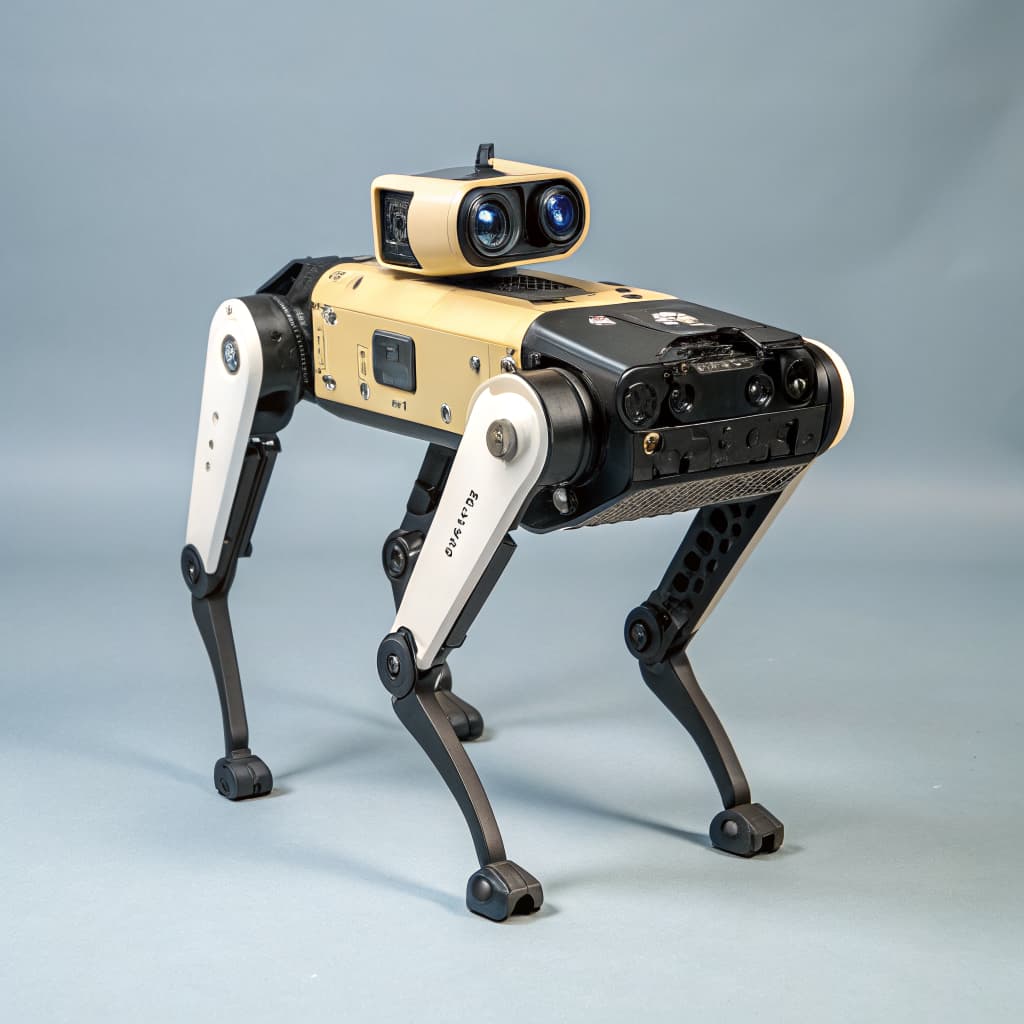

Jueying Mini
Compact quadruped robot for education and research
Contact for pricing
The Jueying Mini is a small-scale quadruped robot developed by Deep Robotics for educational institutions and research applications. Building on Deep Robotics' experience with their larger Jueying series, this compact version offers dynamic locomotion capabilities including trotting, jumping, and autonomous navigation in a more accessible package. Designed for teaching robotics fundamentals and algorithm development, it features open SDK support and ROS compatibility.
Released: 2021
Overview
The Jueying Mini represents Deep Robotics' effort to bring advanced quadruped robotics technology to educational and research institutions at a more accessible scale. As a compact version of their flagship Jueying series, which has been deployed in industrial inspection and public safety applications, the Mini maintains sophisticated locomotion capabilities while being optimized for laboratory and classroom environments.
Weighing just 9 kilograms with a standing height of 280mm, the Jueying Mini delivers impressive agility with a maximum speed of 3.5 m/s and the ability to carry payloads up to 5 kg. Its 12 degrees of freedom enable dynamic gaits including trotting, bounding, and even jumping maneuvers, making it an ideal platform for studying legged locomotion, control algorithms, and autonomous navigation.
Built with education in mind, the platform provides comprehensive SDK support and ROS compatibility, allowing students and researchers to program custom behaviors, test new algorithms, and explore the fundamentals of quadruped robotics. The open development environment combined with robust hardware makes it suitable for both undergraduate teaching labs and graduate-level research projects.
Key Features
- Dynamic Locomotion: Capable of multiple gaits including trotting, bounding, and jumping with smooth transitions
- Open Development Platform: Full SDK support and ROS compatibility for custom programming and algorithm development
- Compact and Portable: 9 kg weight and 280mm height make it easy to transport and use in educational settings
- Robust Payload Capacity: Supports up to 5 kg payload for sensors, computing modules, or experimental equipment
- Extended Runtime: 90-minute battery life enables longer experiments and demonstrations without interruption
- Onboard Sensing: Integrated IMU and depth camera for autonomous navigation and environmental perception
Applications
The Jueying Mini is primarily targeted at universities, research laboratories, and technical training institutions seeking a capable platform for robotics education and research. It serves as an excellent tool for teaching courses in robot dynamics, control theory, computer vision, and autonomous systems, allowing students to experiment with real hardware rather than relying solely on simulation. Research groups use it to prototype and test new algorithms for legged locomotion, path planning, and multi-robot coordination.
Beyond formal education, the platform appeals to corporate R&D teams exploring quadruped robotics applications and robotics competitions where teams need a reliable, programmable quadruped base. Its combination of performance, accessibility, and open architecture makes it suitable for both introductory robotics courses and advanced research in areas like reinforcement learning, bio-inspired locomotion, and terrain adaptation.
Technical Highlights
The Jueying Mini incorporates several technical achievements from Deep Robotics' work on larger commercial platforms. Its proprietary motor control system enables precise torque control across all 12 joints, providing the force feedback necessary for dynamic balance and terrain adaptation. The onboard computing architecture manages real-time control loops at high frequencies while simultaneously processing sensor data and running user-level code, all within a compact and energy-efficient package.
The robot's software stack leverages Deep Robotics' motion control library, which includes pre-programmed gaits and behaviors that users can call through simple APIs, while still allowing low-level access for those wanting to implement custom controllers. The integration of depth sensing with proprioceptive feedback enables basic autonomous navigation and obstacle avoidance out of the box, while the open architecture allows researchers to add additional sensors and computing modules to extend capabilities for specific research applications.
Videos
Specifications
Connectivity
| Communication | WiFi, Ethernet |
Mechanics
| Degrees of Freedom | 12 |
| Locomotion | Quadruped |
Performance
| Max Speed | 1.6 m/s |
| Payload Capacity | 5 kg |
Physical
| Weight | 9 kg |
| Height | 280 mm |
Power
| Battery Life | 1.5 hours |
Sensing
| Sensors | IMU, depth camera |
Software
| SDK Support | Yes |
| ROS Compatible | Yes |
Similar Robots
Ready to deploy Jueying Mini?
Tell us about your use case and we'll help you evaluate this solution.
Trusted by 200+ companies evaluating robotics solutions.