Kinova Gen3
Lightweight 7-DOF collaborative robotic arm platform
Contact for pricing
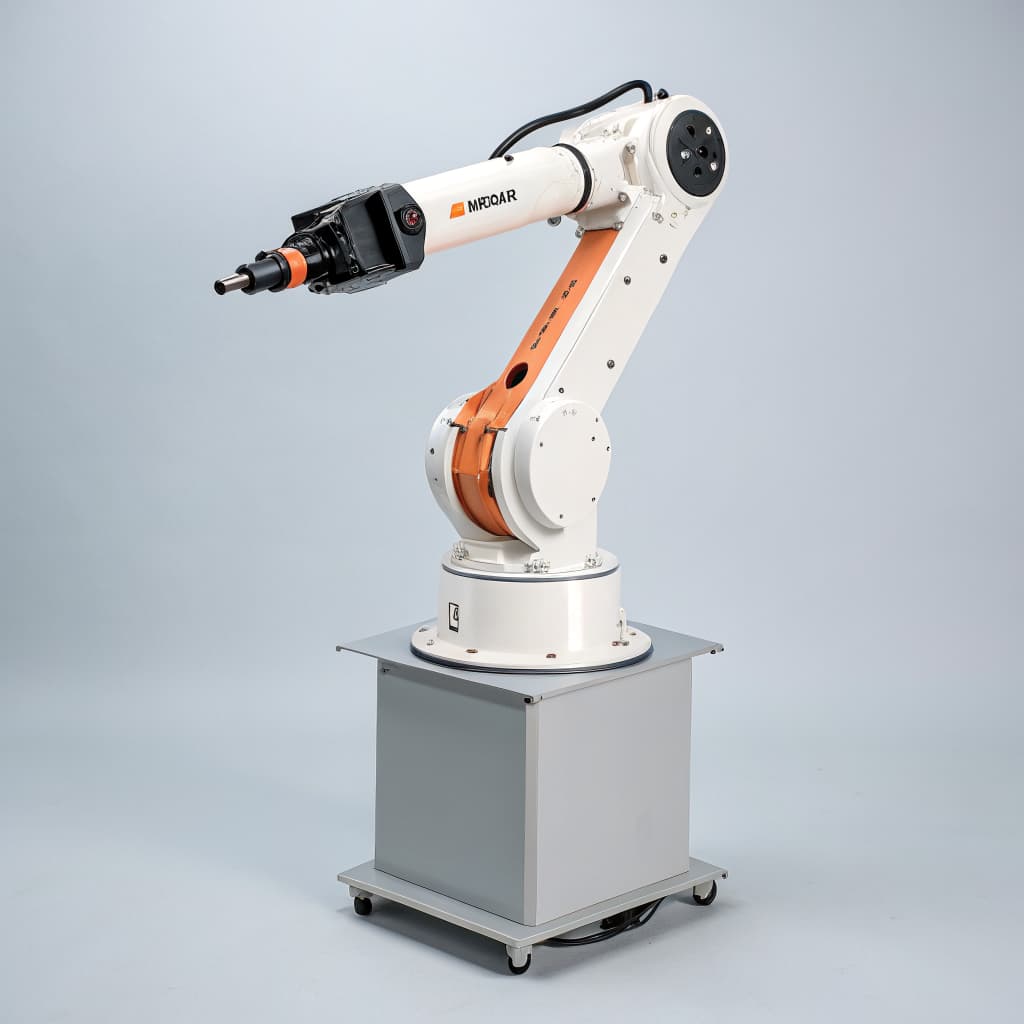
The Kinova Gen3 is a lightweight, 7-degree-of-freedom collaborative robotic arm designed for research, education, and industrial applications. It features advanced torque sensors in each joint, built-in vision capabilities, and extensive API support for custom development. The Gen3 is particularly suited for academic research institutions, automation integrators, and organizations developing assistive robotics solutions.
Released: 2018
Estimated lead time: 8 weeks
Overview
The Kinova Gen3 represents a significant advancement in collaborative robotics, combining precision, safety, and versatility in a lightweight package. Designed as a platform for innovation, the Gen3 serves researchers, educators, and industrial developers who require a highly customizable robotic arm solution. Its 7-degree-of-freedom design provides human-like dexterity and the ability to reach around obstacles while maintaining optimal end-effector positioning.
Built with safety and collaboration in mind, the Gen3 integrates torque sensors in every joint, enabling advanced force control and safe human-robot interaction. The arm's modular design philosophy allows for easy integration with various end-effectors and sensors, making it adaptable to diverse applications from laboratory research to production floor automation.
Kinova designed the Gen3 with an open architecture approach, providing extensive software support including ROS integration, Python and C++ APIs, and compatibility with major robotics frameworks. This openness has made it a popular choice in academic institutions worldwide and among companies developing next-generation automation solutions.
Key Features
- 7-DOF articulation: Provides human-like arm dexterity with redundant degrees of freedom for optimal positioning and obstacle avoidance
- Integrated torque sensors: Each joint features torque sensing for precise force control and safe collaboration
- Vision module compatibility: Optional integrated 2D/3D vision systems for enhanced perception and object recognition
- Modular end-effector interface: Standardized mounting and communication for quick tool changes and custom grippers
- Comprehensive SDK: Full API support with ROS, Python, C++, and MATLAB interfaces for custom application development
- Lightweight design: At 8.2 kg, the arm is easily portable and can be mounted in various orientations including ceiling, wall, or mobile platforms
Applications
The Kinova Gen3 excels in research and development environments where flexibility and programmability are paramount. Academic institutions use it extensively for robotics research, machine learning experiments, and teaching advanced manipulation concepts. In industrial settings, the Gen3 serves as a platform for prototyping automation solutions, testing new gripping strategies, and developing assistive technologies for manufacturing quality control and assembly tasks.
The arm has also found applications in assistive robotics, helping individuals with mobility limitations perform daily tasks. Its safe, collaborative nature and precise control make it ideal for healthcare research, rehabilitation robotics, and service robot development. Industries ranging from aerospace to electronics leverage the Gen3 for tasks requiring delicate manipulation, inspection, and small-scale assembly operations.
Technical Highlights
The standout technical achievement of the Gen3 is its joint-level torque sensing architecture, which enables advanced impedance control and allows the robot to respond dynamically to external forces. This capability makes the arm inherently safe for collaborative applications and enables sophisticated force-controlled operations like polishing, assembly with compliance, and delicate object handling. The 0.1mm repeatability ensures consistent performance for precision tasks.
Kinova's commitment to open-source compatibility sets the Gen3 apart in the collaborative robotics market. The arm's full ROS support, including MoveIt integration, combined with comprehensive documentation and active community support, accelerates development cycles. The modular design allows researchers to customize everything from joint configurations to control algorithms, making it a true platform for innovation rather than a closed proprietary system.
Videos
Deployment Evidence
Kinova Gen3 — Official Product Page
Kinova Gen3 is commercially available in 6-DOF and 7-DOF configurations with official ROS 2 support; widely deployed in assistive robotics and research manipulation tasks.
Introducing ROS 2 Support for Gen3 — Kinova
Kinova officially released ROS 2 support for Gen3 and Gen3 Lite with MoveIt2 integration, maintained at github.com/Kinovarobotics/ros2_kortex.
Deployment Readiness
Integration & SDK
- ROS Support
- Supported
- SDK Available
- Supported
- API Docs
- View Docs
- Supported Platforms
- Linux, Ubuntu 20.04, Ubuntu 22.04, ROS 2 (Humble), Python, C++, MATLAB
Support & Service
Regions
| Tier | Response Time | SLA |
|---|---|---|
| Standard | 48 hrs | — |
| Premium | 8 hrs | — |
Specifications
Connectivity
| Communication | Ethernet, USB |
Mechanics
| Degrees of Freedom | 7 |
| Locomotion | Stationary |
Performance
| Payload Capacity | 4 kg |
| Reach | 902 mm |
| Repeatability | 0.1 mm |
Physical
| Weight | 8.2 kg |
Software
| SDK Support | Yes |
| ROS Compatible | Yes |
Ready to deploy Kinova Gen3?
Tell us about your use case and we'll help you evaluate this solution.
Trusted by 200+ companies evaluating robotics solutions.