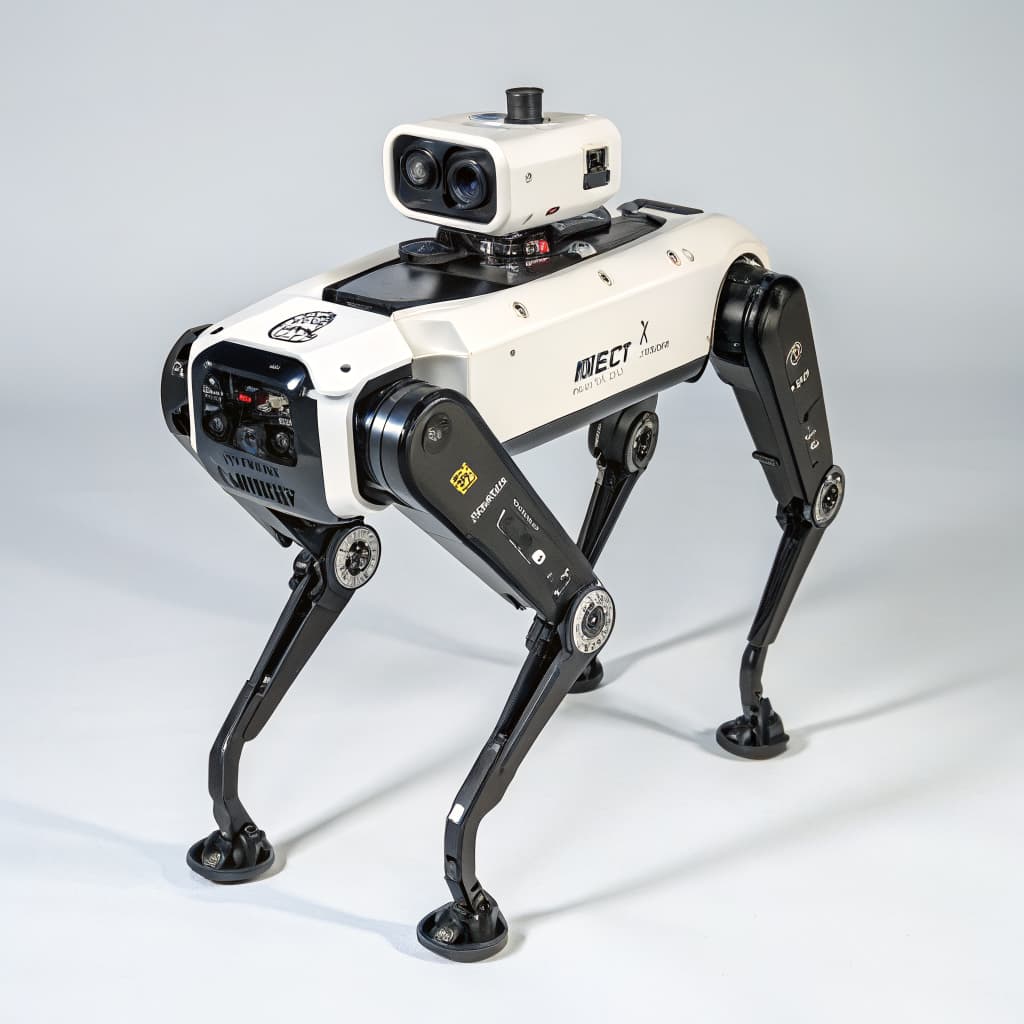

Max
Advanced Quadruped Robot for Demanding Environments
Contact for pricing
Max is Ghost Robotics' premier quadruped robot designed for military, defense, and industrial applications in challenging terrains and hazardous environments. It features robust construction, autonomous navigation capabilities, and the ability to carry various payloads including sensors and communication equipment. The platform is built for reliability in extreme conditions with proven deployment across government and commercial sectors.
Released: 2020
Overview
Ghost Robotics' Max is a highly capable quadruped unmanned ground vehicle (Q-UGV) designed to operate in the world's most demanding and dangerous environments. With its direct-drive electric motor architecture and robust mechanical design, Max delivers exceptional mobility across challenging terrain including sand, mud, rocks, and stairs while maintaining operational stability.
Developed with a focus on mission-critical reliability, Max has been deployed by military, homeland security, and commercial organizations worldwide. The platform's modular design allows for rapid integration of various payloads and sensors, making it adaptable to diverse mission requirements from perimeter security and reconnaissance to hazardous material inspection and remote sensing.
Max represents Ghost Robotics' commitment to creating practical, field-ready robotic systems rather than laboratory prototypes. Its weatherproof construction, extended battery life, and autonomous navigation capabilities make it a trusted platform for operations where human presence would be dangerous or impractical.
Key Features
- Direct-Drive Actuation: Proprietary electric motor system eliminates gearboxes for increased reliability and reduced maintenance
- All-Terrain Mobility: Navigates complex environments including stairs, rocks, sand, and debris with stable four-legged locomotion
- Modular Payload Integration: Quick-attach payload rails support up to 14 kg of sensors, communication equipment, or mission-specific tools
- Autonomous Navigation: GPS-denied navigation capabilities with obstacle avoidance and path planning
- Weatherproof Design: IP54 rating enables operation in rain, dust, and extreme temperatures from -20°C to 55°C
- Extended Runtime: Up to 3 hours of continuous operation with hot-swappable battery option for extended missions
- Remote Operation: Controlled via handheld tablet or autonomous waypoint navigation with real-time video feedback
Applications
Max has been deployed across military bases, critical infrastructure sites, and industrial facilities for a wide range of security and inspection missions. The U.S. Air Force has utilized Max for base security patrols, perimeter monitoring, and force protection operations. In commercial settings, Max serves in oil and gas facility inspections, construction site monitoring, and emergency response scenarios where hazardous conditions prevent human access.
The platform excels in border patrol operations, providing persistent surveillance in remote and rugged terrain. Max has also proven valuable for explosive ordnance disposal (EOD) teams, CBRN (chemical, biological, radiological, nuclear) reconnaissance, and disaster response missions where its mobility and sensor integration capabilities enable safe assessment of dangerous situations from a standoff distance.
Technical Highlights
Ghost Robotics' proprietary direct-drive actuator technology sets Max apart from competing quadruped platforms. By eliminating traditional gearboxes and using custom electric motors with integrated electronics, Max achieves superior reliability with fewer mechanical failure points. This design philosophy results in a robot that requires minimal maintenance and can sustain impacts and environmental stresses that would disable gear-driven systems.
The platform's control architecture enables both teleoperation and autonomous behaviors, with onboard processing handling real-time terrain adaptation and dynamic balancing. Max can recover from slips, navigate uneven surfaces, and maintain stability while carrying asymmetric payloads. Its modular software architecture supports rapid integration of third-party sensors and AI capabilities, making it a versatile platform for evolving mission requirements and emerging technologies.
Videos
Specifications
Environment
| Operating Temperature | -40°C to 55°C |
| IP Rating | IP54 |
Mechanics
| Locomotion | Quadruped |
Performance
| Max Speed | 1.6 m/s |
| Payload Capacity | 14 kg |
Physical
| Weight | 32 kg |
Power
| Battery Life | 3 hours |
Similar Robots
Ready to deploy Max?
Tell us about your use case and we'll help you evaluate this solution.
Trusted by 200+ companies evaluating robotics solutions.