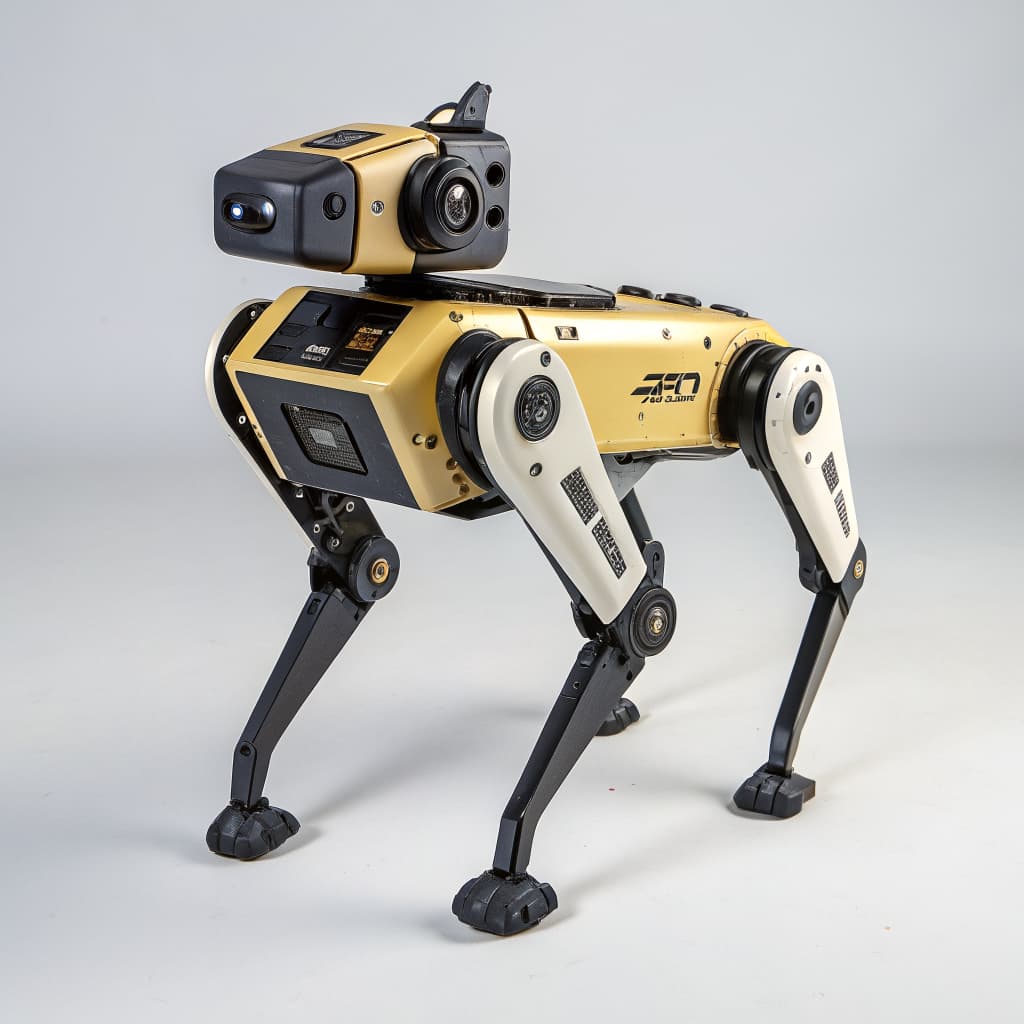

Mini Pupper
Open-source quadruped robot for education and research
$299 – $899
Mini Pupper is an open-source quadruped robot dog designed by MangDang for robotics education, STEM learning, and research applications. Built with 12 degrees of freedom and ROS 2 compatibility, it provides an accessible platform for learning robot kinematics, AI vision, and autonomous navigation. The robot targets students, hobbyists, and researchers seeking an affordable entry point into legged robotics.
Released: 2021
Overview
Mini Pupper represents a breakthrough in accessible robotics education, bringing quadruped robot technology to students and makers worldwide. Developed by MangDang, this palm-sized robot dog combines sophisticated hardware with open-source software, making advanced robotics concepts tangible and approachable. With its compact 160mm height and lightweight 560g design, Mini Pupper delivers impressive agility and performance in a package that fits on any desk.
The robot's design philosophy centers on openness and extensibility. Every aspect of Mini Pupper is open-source, from mechanical CAD files to firmware and control algorithms. This transparency enables users to not just program the robot, but to truly understand how quadruped locomotion works at a fundamental level. Built on ROS 2 (Robot Operating System 2), Mini Pupper integrates seamlessly with the broader robotics ecosystem, allowing students to apply industry-standard tools and workflows.
Mini Pupper serves as an ideal platform for hands-on learning in robotics, computer vision, and artificial intelligence. Whether exploring inverse kinematics, implementing SLAM algorithms, or training reinforcement learning models, the robot provides a physical testbed where theory meets practice. Its growing community of developers and educators continuously contributes new capabilities, tutorials, and educational resources.
Key Features
- 12 DOF Articulation: Three-axis servos on each leg enable natural quadruped gaits including walk, trot, and dynamic movement patterns
- ROS 2 Native Support: Full integration with Robot Operating System 2 for professional-grade development and compatibility with extensive ROS packages
- Raspberry Pi Powered: Runs on Raspberry Pi 4 with sufficient computing power for autonomous navigation and real-time control
- Open-Source Everything: Complete access to hardware designs, firmware, kinematics libraries, and simulation models for unlimited customization
- Visual Programming Support: Compatible with Stanford Pupper and OpenCat frameworks, plus block-based programming options for beginners
- Modular Design: Easy assembly with 3D-printed components and standardized servo interfaces for modifications and upgrades
- AI Vision Ready: Optional camera module and pre-configured OpenCV support for object detection and autonomous behavior
- Active Community: Large user base contributing code, sharing projects, and providing support through forums and social media
Applications
Mini Pupper excels in educational environments from middle schools to universities. Computer science and engineering programs use it to teach robotics fundamentals, including kinematics, sensor fusion, and autonomous navigation. The robot's approachable scale and cost make it feasible to deploy in classroom sets, allowing every student hands-on experience. STEM programs leverage Mini Pupper to demonstrate real-world applications of mathematics and physics, showing how equations translate into physical motion.
Researchers and hobbyists adopt Mini Pupper as a rapid prototyping platform for quadruped locomotion algorithms. Its open architecture enables testing new gait patterns, control strategies, and AI models without the cost and complexity of industrial-grade platforms. The robot has been used in undergraduate research projects, robotics competitions, and as a test platform for reinforcement learning experiments in legged locomotion.
Technical Highlights
The mechanical design of Mini Pupper demonstrates careful engineering optimization for its educational mission. Each leg incorporates three high-torque digital servos arranged to provide hip, shoulder, and knee articulation, achieving the 12-degree-of-freedom configuration essential for stable quadruped locomotion. The structural components use 3D-printed parts combined with aluminum brackets, balancing durability with accessibility for users who want to modify or repair their robots.
On the software side, Mini Pupper implements sophisticated inverse kinematics algorithms that translate desired foot positions into servo angles in real-time. The ROS 2 integration provides access to navigation stacks, visualization tools, and simulation environments like Gazebo. Users can develop code in simulation before deploying to the physical robot, significantly accelerating the learning process. The inclusion of IMU sensor data enables dynamic balance compensation, allowing Mini Pupper to handle uneven terrain and recover from disturbances with surprising grace for its size and price point.
Videos
Specifications
Connectivity
| Communication | WiFi |
Mechanics
| Degrees of Freedom | 12 |
| Locomotion | Quadruped |
Performance
| Max Speed | 0.16 m/s |
Physical
| Weight | 0.56 kg |
| Height | 160 mm |
Power
| Battery Life | 0.5 hours |
Sensing
| Sensors | IMU, camera |
Software
| SDK Support | Yes |
| ROS Compatible | Yes |
Similar Robots
Ready to deploy Mini Pupper?
Tell us about your use case and we'll help you evaluate this solution.
Trusted by 200+ companies evaluating robotics solutions.