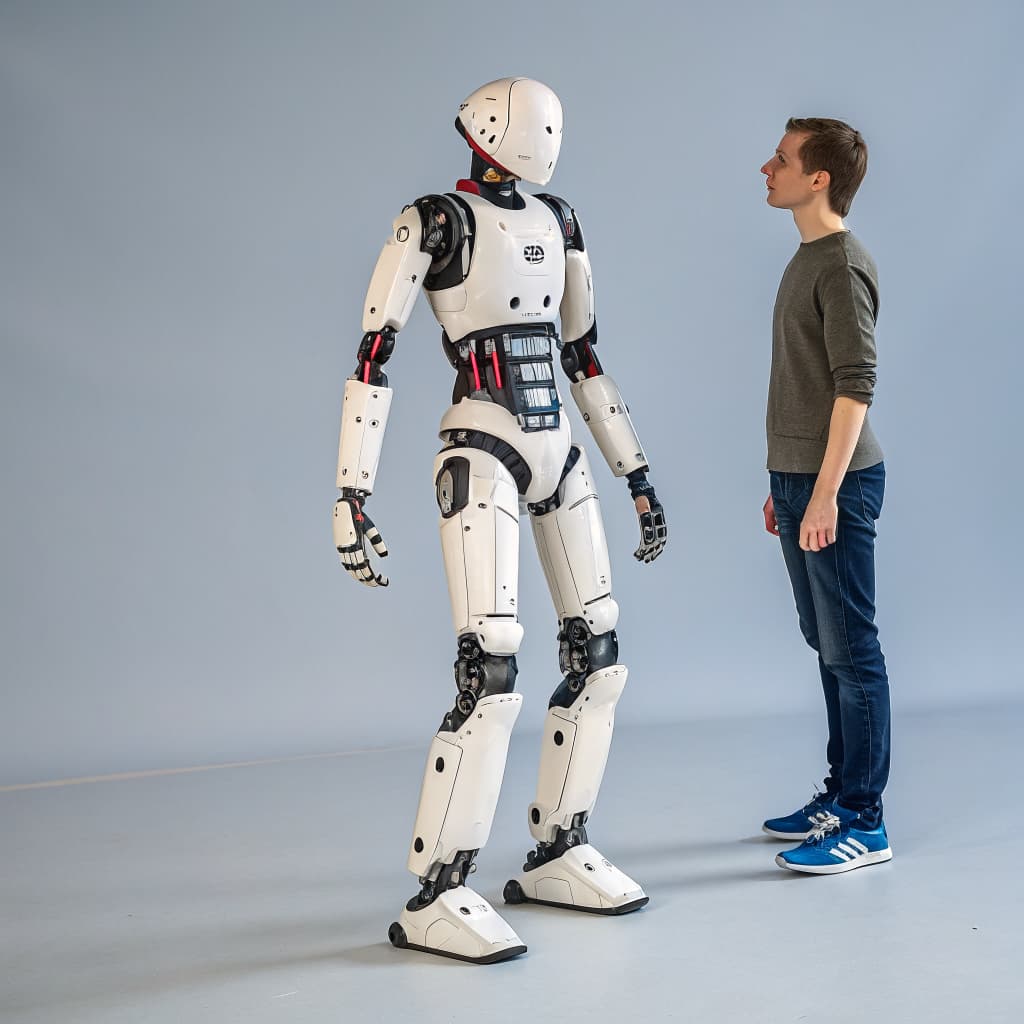
Romeo
Full-size humanoid research platform for assisting people
Price
Price not publicly disclosed
Record checked Jul 10, 2026
Key facts
Values reflect the public record
- Height
- 1467 mmManufacturer confirmed
- Weight
- 36.66 kgManufacturer confirmed
- Payload
- No public data documented
- Degrees of freedom
- 37Manufacturer confirmed
- Runtime
- No public data documented
- Max speed
- No public data documented
Canonical robot record
Overview
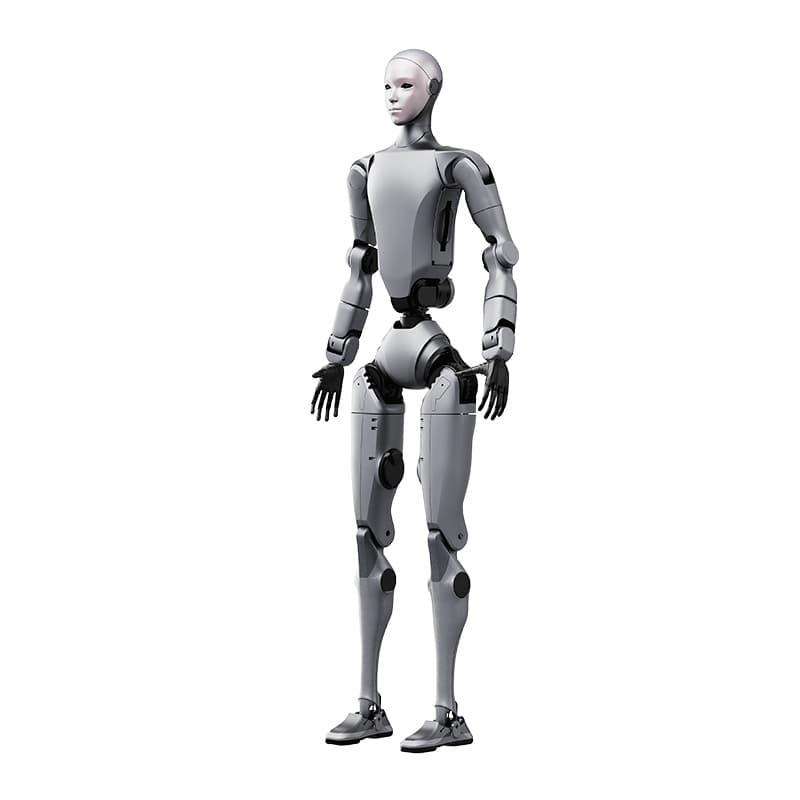
Romeo is a full-size humanoid robot created by Aldebaran (the robotics maker now continued by Maxtronics, based in Issy-les-Moulineaux, France) as a research platform. Its stated goal was to investigate how a service robot could support elderly or dependent people in everyday tasks around the home and act as a companion that helps look after their wellbeing.
Mechanically, Romeo is articulated like a person, with a head, two arms with multi-jointed wrists, a yawing trunk, and legs with hips, knees, ankles, and articulated toes, plus movable eyes. It is documented and programmed through the same NAOqi developer framework used across the maker's robot family, exposing its joints, motors, sensors, and kinematics to developers.
Romeo is a research and development effort rather than a product that was sold commercially. It does not appear in the manufacturer's current product range, which today centers on the NAO robot, so Romeo should be understood as an experimental platform rather than a shipping or supported device.
RoboZaps maintains this record as part of its canonical robotics database. Specs are source-verified where linked; the record compares public facts across manufacturers rather than representing a single robot maker.
- Spec sources
- 5 linked
- Verification
- Verified · 6/6 specs source-verified
- Deployment
- Research platform
- Last verified
- Jul 10, 2026
Key Features
- Full-size, fully articulated humanoid body designed to move and interact at roughly human scale
- Articulated trunk, legs with movable toes, and dexterous multi-finger hands for grasping and manipulation
- Movable eyes and a sensor-equipped head supporting perception and interaction
- Programmable through the maker's NAOqi software framework, with fully documented joints, motors, and kinematics
- Conceived specifically as a research platform for assisting elderly or dependent people
Specifications
Grouped technical data with source detail available on demand.
6 documented values
Connectivity
| Communication | WiFi, EthernetManufacturer confirmedVerified Jul 10, 2026 Aldebaran/SoftBank Robotics official documentation (opens in a new tab) |
|---|
Mechanics
| Degrees of Freedom | 37Manufacturer confirmed |
|---|---|
| Locomotion | BipedalThird-party sourceVerified Jul 10, 2026 IEEE Spectrum (opens in a new tab) |
Physical
| Height | 1467 mmManufacturer confirmedVerified Jul 10, 2026 Aldebaran/SoftBank Robotics official documentation (opens in a new tab) |
|---|---|
| Weight | 36.66 kgManufacturer confirmedVerified Jul 10, 2026 Aldebaran/SoftBank Robotics official documentation (opens in a new tab) |
Sensing
| Sensors | Four 2D cameras (eyes + forehead) and one 3D depth sensor (ASUS Xtion), microphones; joint torque inferred from motor current (no dedicated force sensors)Manufacturer confirmedVerified Jul 10, 2026 Aldebaran/SoftBank Robotics official documentation (opens in a new tab) |
|---|
Evidence & changelog
Sources behind this record and material corrections made over time.
Sources
- Aldebaran/SoftBank Robotics official documentation - tranche-8 verification (opens in a new tab) · Aldebaran/SoftBank Robotics official documentation — cites Height, Weight
- Aldebaran/SoftBank Robotics official documentation (model 'Romeo H37') + IEEE Spectrum - tranche-8 verification (opens in a new tab) · Aldebaran/SoftBank Robotics official documentation (model 'Romeo H37') + IEEE Spectrum — cites Degrees of Freedom
- Aldebaran/SoftBank Robotics official documentation - tranche-8 verification (opens in a new tab) · Aldebaran/SoftBank Robotics official documentation — cites Communication
- Aldebaran/SoftBank Robotics official documentation - tranche-8 verification (opens in a new tab) · Aldebaran/SoftBank Robotics official documentation — cites Sensors
- IEEE Spectrum - tranche-8 verification (opens in a new tab) · IEEE Spectrum — cites Locomotion
Record changelog
- Sensors: Cameras, inertial sensors, force sensors, sonars changed to Four 2D cameras (eyes + forehead) and one 3D depth sensor (ASUS Xtion), microphones; joint torque inferred from motor current (no dedicated force sensors) · Jul 10, 2026
tranche-8 verification (corrected): Official docs list 4x 2D cameras + optional ASUS Xtion 3D sensor, microphones, loudspeakers, LEDs - no sonar page exists (sonars look like NAO/Pepper spec bleed). I
- Weight: 40 kg changed to 36.66 kg · Jul 10, 2026
tranche-8 verification (corrected): Official construction page: Mass 36.66 kg. The widely quoted 40 kg (IEEE 2010) was the pre-build projection; as-built manufacturer figure is 36.66 kg (Generation Ro
- Height: 1460 mm changed to 1467 mm · Jul 10, 2026
tranche-8 verification (corrected): Official construction page: Height 1467 mm. Press rounds to 1.4 m / 140 cm; stored 1460 was close but not the datasheet figure.
Media
Manufacturer
Creator of NAO and Pepper humanoid robots for education, research, and customer service applications.
- Headquarters
- Paris, France
- Founded
- 2005