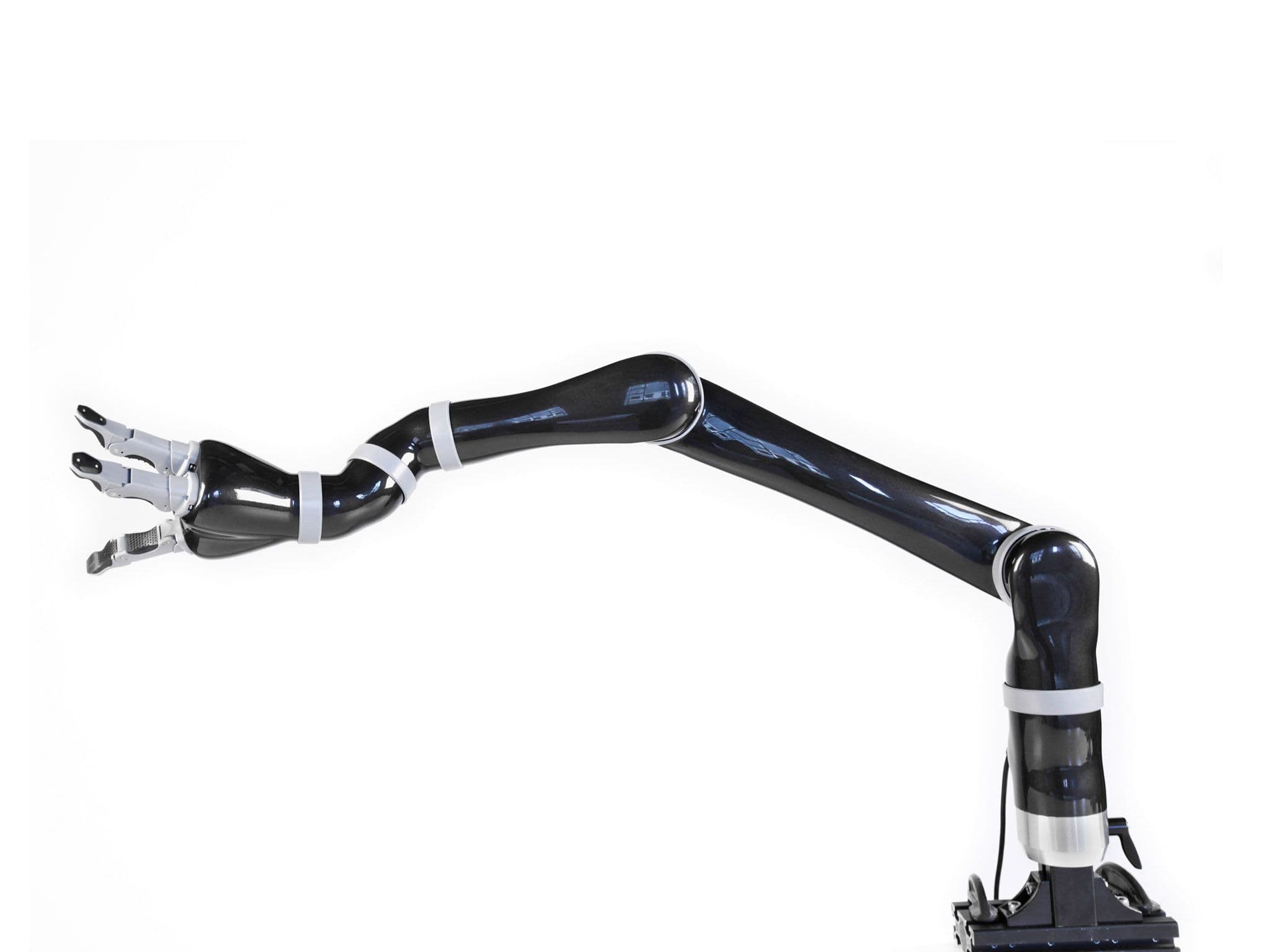

Jaco
Assistive robotic arm for enhanced independence
Contact for pricing
Jaco is a lightweight, highly dexterous robotic arm designed primarily for assistive applications to help individuals with upper-body mobility limitations. Featuring 6 degrees of freedom and a unique three-fingered hand, it can perform complex manipulation tasks like eating, drinking, and personal care. The arm is wheelchair-mountable and controlled through various interfaces including joysticks, touchscreens, and voice commands, serving markets in assistive technology, research, and service robotics.
Released: 2011
Overview
The Jaco robotic arm by Kinova Robotics represents a breakthrough in assistive technology, combining advanced robotics with user-centered design to enhance independence for people with upper-body mobility impairments. Launched in 2011, Jaco was designed from the ground up to be lightweight, safe, and intuitive enough for daily use in home and community settings. Its carbon fiber construction and compact form factor make it ideal for wheelchair mounting without adding excessive weight or bulk.
What distinguishes Jaco from industrial manipulators is its three-fingered hand capable of human-like grasping patterns and its focus on safety and ease of use. The arm operates at low speeds with compliant actuation, ensuring safe interaction in unstructured human environments. Multiple control modalities—including joystick, touchscreen, and voice control—allow users to operate the arm according to their individual capabilities and preferences.
Beyond assistive applications, Jaco has gained widespread adoption in research institutions and educational settings worldwide. Its open architecture, ROS compatibility, and comprehensive SDK have made it a popular platform for advancing manipulation research, human-robot interaction studies, and robotics education.
Key Features
- Three-Fingered Hand: Unique underactuated gripper enables adaptive grasping of objects with varying shapes and sizes
- Lightweight Design: 4.4 kg carbon fiber construction for easy wheelchair mounting and portability
- 6 Degrees of Freedom: Provides human-like arm movement and dexterous manipulation capabilities
- Multiple Control Interfaces: Supports joystick, touchscreen, voice commands, and custom interfaces for accessibility
- Safe Human Interaction: Compliant actuation and low-speed operation ensure safety in home environments
- Open Architecture: Full SDK and ROS support for research, customization, and integration
- Curved Wrist Design: Distinctive curved wrist joint enables unique reach and positioning capabilities
Applications
Jaco's primary application is as an assistive device for individuals with conditions such as muscular dystrophy, spinal cord injuries, cerebral palsy, and other mobility limitations. Users employ Jaco to perform activities of daily living including eating and drinking, personal grooming, picking up and manipulating objects, opening doors, and operating appliances. The arm enables greater independence at home, school, and work environments, reducing reliance on caregivers for routine tasks.
In research and education, Jaco serves as a versatile platform for advancing human-robot interaction, machine learning for manipulation, teleoperation systems, and assistive technology development. Universities and research labs worldwide use Jaco to prototype new control algorithms, test collaborative robotics concepts, and train the next generation of roboticists. Its combination of accessibility, reliability, and open development environment has established it as a standard research platform in academic robotics.
Technical Highlights
Jaco's three-fingered hand represents a significant engineering achievement, utilizing underactuated mechanisms that allow the fingers to automatically conform to object shapes without complex sensing or control. Each finger has multiple joints but is driven by a single actuator, creating passive adaptation during grasping. This design simplifies control while achieving robust manipulation of diverse objects, from small pills to drinking glasses.
The arm's carbon fiber construction achieves an exceptional strength-to-weight ratio, critical for wheelchair mounting applications where added weight directly impacts user mobility. Kinova's proprietary actuator technology integrates motors, transmission, and control electronics into compact modules at each joint, enabling the sleek profile and human-scale dimensions. The curved wrist joint—a distinctive design element—extends the workspace and allows the hand to reach positions that would be impossible with conventional straight-wrist configurations, particularly valuable when mounted on a wheelchair.
Videos
Specifications
Mechanics
| Degrees of Freedom | 6 |
| Locomotion | Stationary |
Performance
| Payload Capacity | 1.5 kg |
| Reach | 900 mm |
| Repeatability | 0.5 mm |
Physical
| Weight | 4.4 kg |
Software
| SDK Support | Yes |
| ROS Compatible | Yes |
Similar Robots
Ready to deploy Jaco?
Tell us about your use case and we'll help you evaluate this solution.
Trusted by 200+ companies evaluating robotics solutions.