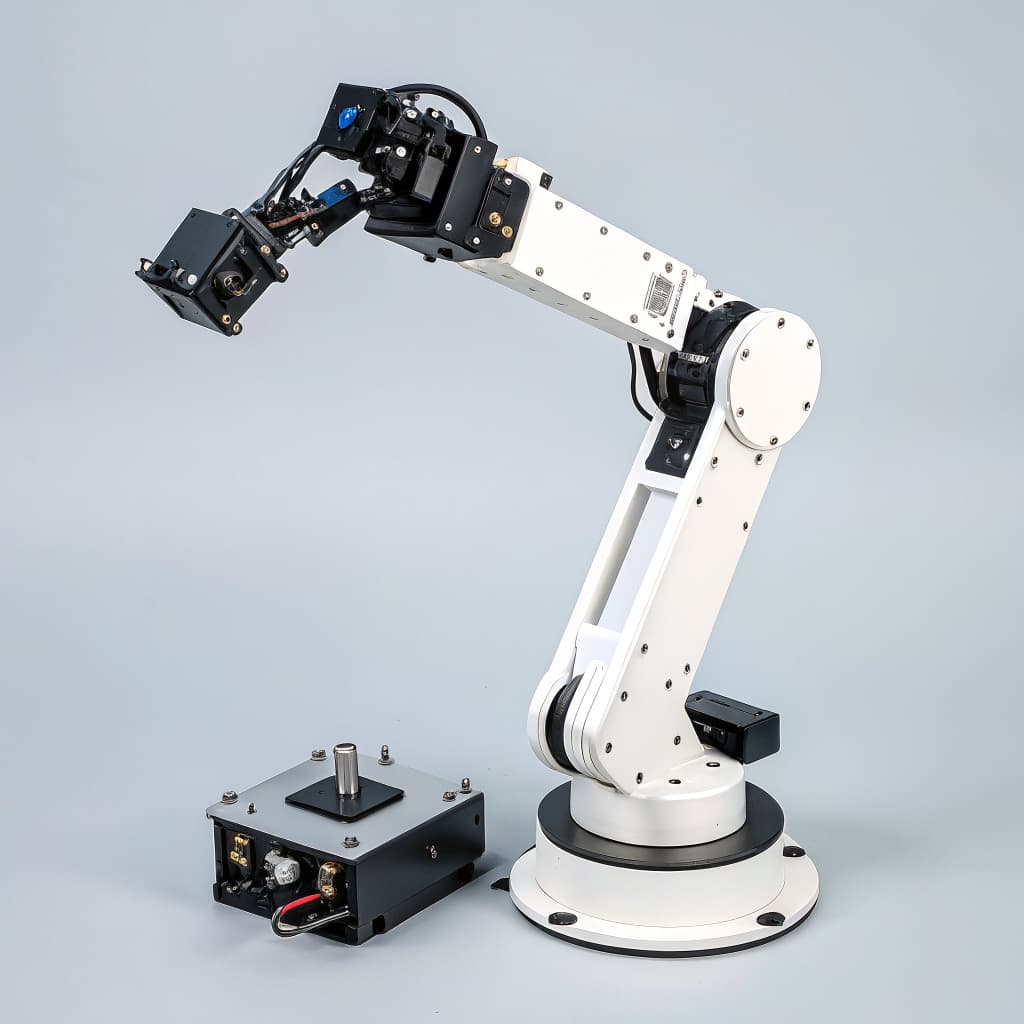

Mercury A1
Humanoid robot for research and commercial applications
Contact for pricing
The Mercury A1 is a full-sized humanoid robot developed by Elephant Robotics featuring 12 degrees of freedom and advanced mobility capabilities. Designed for research institutions, educational purposes, and commercial applications, it combines bipedal locomotion with sophisticated manipulation capabilities through integrated arm systems. The robot supports ROS and provides comprehensive SDK support for custom development and integration.
Released: 2024
Overview
The Mercury A1 represents Elephant Robotics' entry into the humanoid robotics market, combining their expertise in collaborative robotics with advanced bipedal locomotion technology. Built on a modular platform, the Mercury A1 features a human-like form factor designed to navigate environments built for people while performing complex manipulation tasks through its dual-arm configuration.
With 12 degrees of freedom distributed across its locomotion and manipulation systems, the Mercury A1 achieves a balance between mobility and dexterity. The robot's design emphasizes practical deployment in real-world scenarios, featuring robust construction with IP54 rating for operation in varied environments. Its 14 kg payload capacity enables the robot to handle meaningful objects and tools, making it suitable for both research applications and commercial service scenarios.
Elephant Robotics has equipped the Mercury A1 with comprehensive sensing capabilities including LiDAR for navigation, stereo cameras for vision-based tasks, and IMU for balance and orientation. The platform's open architecture supports ROS integration and provides extensive SDK support, enabling researchers and developers to customize behaviors and integrate the robot into existing workflows.
Key Features
- Bipedal Locomotion: Capable of walking at speeds up to 1.6 m/s with stable human-like gait patterns
- High Payload Capacity: 14 kg payload enables handling of tools, objects, and equipment for practical applications
- Advanced Sensing Suite: Integrated LiDAR, stereo cameras, and IMU provide comprehensive environmental awareness and navigation
- Precision Manipulation: 0.03 mm repeatability with 500 mm reach for accurate object handling and task execution
- Extended Runtime: 90-minute battery life supports continuous operation for research and service tasks
- Multi-Protocol Connectivity: WiFi, Ethernet, and 4G communication options for flexible deployment and remote operation
- Open Development Platform: Full ROS compatibility and SDK support for custom application development
- Industrial-Grade Durability: IP54 rating protects against dust and water splashes for reliable operation
Applications
The Mercury A1 is designed for research institutions investigating humanoid robotics, human-robot interaction, and bipedal locomotion. Academic labs can utilize the platform to develop and test algorithms for balance control, path planning, and manipulation in human-centric environments. The robot's open architecture makes it particularly valuable for multi-disciplinary research spanning mechanical engineering, computer science, and cognitive robotics.
In commercial settings, the Mercury A1 targets service robotics applications where human-like form factors provide advantages. Potential deployments include hospitality environments for guest services, logistics facilities for material handling in constrained spaces, and manufacturing settings where bipedal mobility enables access to areas designed for human workers. The combination of mobility, manipulation capability, and payload capacity positions the robot for practical deployment in scenarios requiring both navigation and task execution.
Technical Highlights
The Mercury A1's bipedal locomotion system represents a significant technical achievement, enabling stable walking at 1.6 m/s while maintaining balance through real-time IMU feedback and sophisticated control algorithms. The 12-degree-of-freedom configuration is optimized to provide essential mobility and manipulation capabilities while maintaining mechanical simplicity and reliability. The robot's sub-0.1mm repeatability in manipulation tasks demonstrates precision engineering typically found in industrial robotic arms, now integrated into a mobile humanoid platform.
Elephant Robotics has implemented a comprehensive sensor fusion architecture that combines LiDAR-based SLAM for navigation with stereo vision for object recognition and manipulation guidance. The multi-protocol communication system supports both local operation and cloud connectivity, enabling teleoperation, remote monitoring, and distributed computing for complex AI workloads. The modular software architecture built on ROS provides researchers with access to low-level control while maintaining high-level APIs for rapid application development, striking a balance between flexibility and ease of use.
Specifications
Connectivity
| Communication | WiFi, Ethernet, 4G |
Environment
| IP Rating | IP54 |
Mechanics
| Degrees of Freedom | 12 |
| Locomotion | Stationary |
Performance
| Max Speed | 1.6 m/s |
| Payload Capacity | 14 kg |
| Reach | 500 mm |
| Repeatability | 0.03 mm |
Physical
| Weight | 32.7 kg |
Power
| Battery Life | 1.5 hours |
Sensing
| Sensors | LiDAR, stereo cameras, IMU |
Software
| SDK Support | Yes |
| ROS Compatible | Yes |
Similar Robots
Ready to deploy Mercury A1?
Tell us about your use case and we'll help you evaluate this solution.
Trusted by 200+ companies evaluating robotics solutions.