LIMO
Multi-modal ROS mobile robot development platform
Price
Price not publicly disclosed
Record checked Jul 9, 2026
Key facts
Values reflect the public record
- Height
- 251 mmManufacturer confirmed
- Weight
- 4.8 kgManufacturer confirmed
- Payload
- 4 kgManufacturer confirmed
- Degrees of freedom
- No public data documented
- Runtime
- 40 min (working time); 2 h standbyManufacturer confirmed
- Max speed
- 1 m/s (no load)Manufacturer confirmed
Canonical robot record
Overview
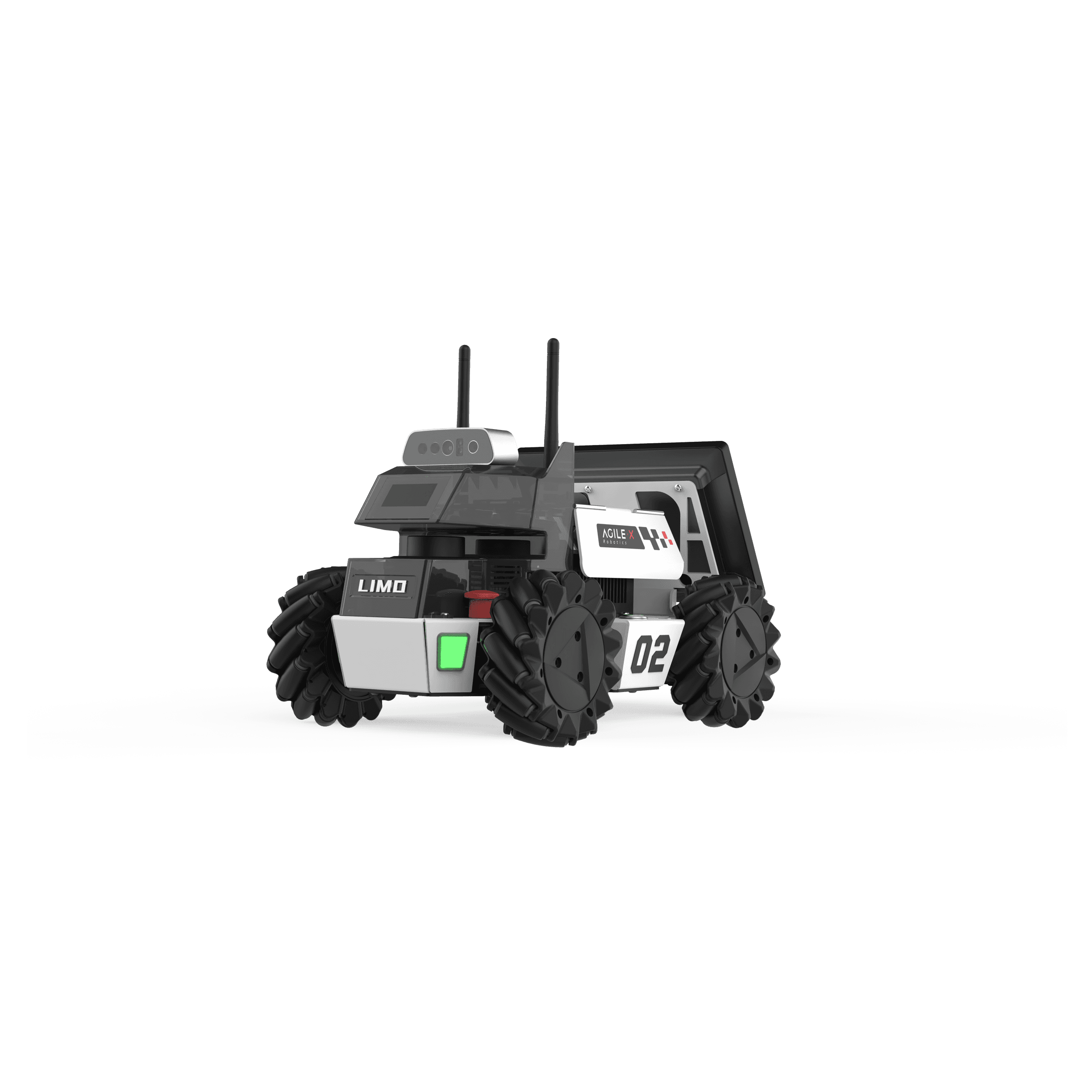
Limo is a multi-modal mobile robot development platform from AgileX Robotics, designed primarily for robotics education, research, and rapid prototyping. It runs on ROS (both ROS 1 and ROS 2 across its variants) and ships with demos and examples so that beginners and advanced developers can experiment with autonomous mobility out of the box.
A defining characteristic of Limo is its ability to switch between several steering and locomotion modes on the same chassis, letting users explore how different drive configurations behave across surfaces and tasks. Onboard sensing includes a scanning LiDAR and a depth camera, supporting SLAM, mapping, path planning, navigation, and obstacle avoidance.
AgileX offers Limo in multiple configurations aimed at different computing and curriculum needs, and positions the platform both as a teaching tool and as a reference for commercial and industrial robotics development.
RoboZaps maintains this record as part of its canonical robotics database. Specs are source-verified where linked; the record compares public facts across manufacturers rather than representing a single robot maker.
- Spec sources
- 2 linked
- Verification
- Verified · 10/10 specs source-verified
- Deployment
- Paid Deployment
- Last verified
- Jul 9, 2026
Key Features
- Switchable steering and locomotion modes (four-wheel differential, Ackermann, tracked, and omni-wheel) on a single chassis
- Onboard scanning LiDAR and a depth camera for SLAM, navigation, and obstacle avoidance
- Native ROS support with preinstalled demos and examples for education and research
- Offered in multiple compute configurations across the Limo product line for different curricula and workloads
Specifications
Grouped technical data with source detail available on demand.
10 documented values
Connectivity
| Communication | WiFi, BluetoothManufacturer confirmedVerified Jul 9, 2026 AgileX Robotics (LIMO user manual, official GitHub) (opens in a new tab) |
|---|
Mechanics
| Locomotion | WheeledManufacturer confirmedVerified Jul 9, 2026 AgileX Robotics (LIMO user manual, official GitHub) (opens in a new tab) |
|---|
Performance
| Max Speed | 1 m/s (no load)Manufacturer confirmedVerified Jul 9, 2026 AgileX Robotics (LIMO user manual, official GitHub) (opens in a new tab) |
|---|---|
| Payload Capacity | 4 kgManufacturer confirmedVerified Jul 9, 2026 AgileX Robotics (LIMO user manual, official GitHub) (opens in a new tab) |
Physical
| Height | 251 mmManufacturer confirmedVerified Jul 9, 2026 AgileX Robotics (LIMO user manual, official GitHub) (opens in a new tab) |
|---|---|
| Weight | 4.8 kgManufacturer confirmedVerified Jul 9, 2026 AgileX Robotics (LIMO user manual, official GitHub) (opens in a new tab) |
Power
| Runtime | 40 min (working time); 2 h standbyManufacturer confirmedVerified Jul 9, 2026 AgileX Robotics (LIMO user manual, official GitHub) (opens in a new tab) |
|---|
Sensing
| Sensors | LiDAR, depth camera, IMUManufacturer confirmedVerified Jul 9, 2026 AgileX Robotics (LIMO user manual, official GitHub) (opens in a new tab) |
|---|
Software
| ROS Compatible | YesPress releaseVerified Jul 9, 2026 GlobeNewswire (AgileX Robotics press release) (opens in a new tab) |
|---|---|
| SDK Support | YesManufacturer confirmedVerified Jul 9, 2026 AgileX Robotics (LIMO user manual, official GitHub) (opens in a new tab) |
Evidence & changelog
Sources behind this record and material corrections made over time.
Sources
- AgileX Robotics (LIMO user manual, official GitHub) - tranche-6 verification (opens in a new tab) · AgileX Robotics (LIMO user manual, official GitHub) — cites Locomotion, Sensors, Communication, SDK Support, Height, Max Speed, Battery Life, Payload Capacity, Weight
- GlobeNewswire (AgileX Robotics press release) - tranche-6 verification (opens in a new tab) · GlobeNewswire (AgileX Robotics press release) — cites ROS Compatible
Record changelog
- Battery Life: 120 min changed to 40 min (working time); 2 h standby · Jul 9, 2026
tranche-6 verification (corrected): Manual: battery 12V 5200mAh, 'Working time: 40 min', 'Stand-by time: 2 h'. The record's 120 min is the STANDBY time mislabeled as runtime (runtime-vs-standby confla
- Max Speed: 1.5 m/s changed to 1 m/s (no load) · Jul 9, 2026
tranche-6 verification (corrected): Manual: 'No-load max speed: 1 m/s'. 1.5 m/s is Scout 2.0-family bleed; no LIMO source publishes 1.5.
- Height: 220 mm changed to 251 mm · Jul 9, 2026
tranche-6 verification (corrected): Overall dimension 322*220*251 mm — 220 is the WIDTH; height is 251 mm (dimension-order defect class). Trossen prints 322x215x247.
- Communication: WiFi, Ethernet changed to WiFi, Bluetooth · Jul 9, 2026
tranche-6 verification (corrected): Manual/Trossen docs list Wi-Fi and Bluetooth (antennas on Jetson Nano carrier); Ethernet is not documented as a LIMO interface.
Media
Manufacturer
Developer of mobile robot chassis and unmanned ground vehicles for research, education, and industrial applications.
- Headquarters
- Shenzhen, China
- Founded
- 2016