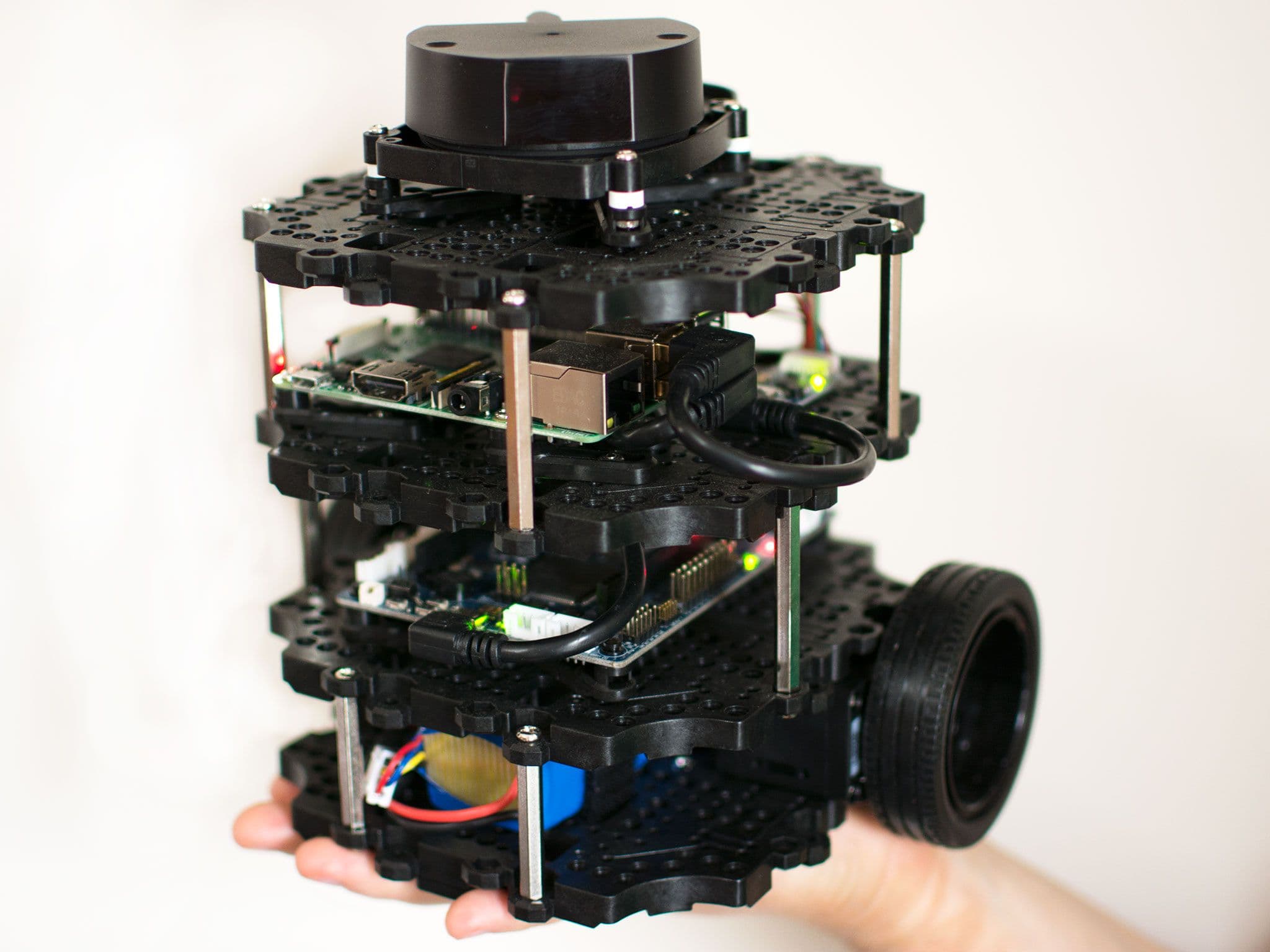
TurtleBot 3 Burger
Open-source ROS-based mobile robot for education and research
Price
$784
Record checked Jul 8, 2026
Key facts
Values reflect the public record
- Height
- 192 mmManufacturer confirmed
- Weight
- 1.0 kgManufacturer confirmed
- Payload
- 15 kgManufacturer confirmed
- Degrees of freedom
- No public data documented
- Runtime
- 2 h 30 m (expected operating time)Manufacturer confirmed
- Max speed
- 0.22 m/sManufacturer confirmed
Canonical robot record
Overview
The TurtleBot3 Burger is the smallest and most affordable model in ROBOTIS's TurtleBot3 family, a small, low-cost, fully customizable mobile robot platform built around the Robot Operating System (ROS). It was developed by ROBOTIS in collaboration with Open Robotics and numerous academic and industry partners as an official ROS education platform, designed to lower the barrier to entry for learning robotics, SLAM, and autonomous navigation.
The platform is intended for education, research, hobby projects, and product prototyping. Its hardware, firmware, and software are all open source, meaning users are free to download, modify, and share the source code, and the 3D CAD data for its injection-molded plastic components is also published so parts can be reproduced via 3D printing.
The Burger combines a Raspberry Pi single-board computer, the open-source OpenCR control board, a 360-degree laser distance sensor for mapping, an inertial measurement unit, and DYNAMIXEL smart servo actuators for its drive wheels, making it well suited to teaching the core technologies of SLAM, navigation, and manipulation.
RoboZaps maintains this record as part of its canonical robotics database. Specs are source-verified where linked; the record compares public facts across manufacturers rather than representing a single robot maker.
- Spec sources
- 1 linked
- Verification
- Verified · 10/10 specs source-verified
- Deployment
- Paid Deployment
- Last verified
- Jul 8, 2026
Key Features
- Fully open-source hardware, firmware, and software, with published 3D CAD data for self-fabrication
- 360-degree laser distance sensor (LiDAR) enabling SLAM and autonomous navigation
- DYNAMIXEL smart servo actuators driving the wheels for precise, controllable motion
- Raspberry Pi single-board computer paired with the open-source OpenCR control board
- Modular, stackable design that can be customized and extended for research and prototyping
Specifications
Grouped technical data with source detail available on demand.
12 documented values
Connectivity
| Communication | WiFiManufacturer confirmedVerified Jul 8, 2026 ROBOTIS e-Manual (opens in a new tab) |
|---|
Mechanics
| Locomotion | WheeledManufacturer confirmedVerified Jul 8, 2026 ROBOTIS e-Manual (opens in a new tab) |
|---|
Performance
| Max Speed | 0.22 m/sManufacturer confirmedVerified Jul 8, 2026 ROBOTIS e-Manual (opens in a new tab) |
|---|---|
| Payload Capacity | 15 kgManufacturer confirmedVerified Jul 8, 2026 ROBOTIS e-Manual (opens in a new tab) |
Physical
| Height | 192 mmManufacturer confirmedVerified Jul 8, 2026 ROBOTIS e-Manual (opens in a new tab) |
|---|---|
| Weight | 1.0 kgManufacturer confirmedVerified Jul 8, 2026 ROBOTIS e-Manual (opens in a new tab) |
| Width | 178 mm Unverified |
| Depth | 138 mm Unverified |
Power
| Runtime | 2 h 30 m (expected operating time)Manufacturer confirmedVerified Jul 8, 2026 ROBOTIS e-Manual (opens in a new tab) |
|---|
Sensing
| Sensors | 360° LiDAR (LDS-02; LDS-01 in pre-2022 units), 3-axis gyro/accelerometer IMU, wheel encodersManufacturer confirmedVerified Jul 8, 2026 ROBOTIS e-Manual (opens in a new tab) |
|---|
Software
| ROS Compatible | YesManufacturer confirmedVerified Jul 8, 2026 ROBOTIS e-Manual (opens in a new tab) |
|---|---|
| SDK Support | YesManufacturer confirmedVerified Jul 8, 2026 ROBOTIS e-Manual (opens in a new tab) |
Deployment and commercial evidence
Deployment evidence
TurtleBot 3 Features — ROBOTIS Official Documentation
TurtleBot 3 is the world's most popular education and research robot for ROS, with hundreds of thousands deployed in universities and research institutions globally over 15+ years.
Integration & SDK
- ROS support
- Supported
- SDK available
- Supported
- API docs
- View docs (opens in a new tab)
- Supported platforms
- Linux, Ubuntu, ROS 1 (Melodic, Noetic), ROS 2 (Foxy, Humble), Python, C++
Support & service
Regions
| Tier | Response time | SLA |
|---|---|---|
| Standard | 72 hrs | — |
Evidence & changelog
Sources behind this record and material corrections made over time.
Sources
- ROBOTIS e-Manual - record-surgery-5 (opens in a new tab) · ROBOTIS e-Manual — cites Locomotion, Sensors, Communication, SDK Support, ROS Compatible, Height, Max Speed, Battery Life, Payload Capacity, Weight
Record changelog
- Battery Life: 140 min changed to 2 h 30 m (expected operating time) · Jul 8, 2026
tranche-5 verification (corrected): ROBOTIS states expected operating time 2h 30m (150 min) for Burger; 140 min matches no published figure (Waffle Pi is 2h). Same 2h30m figure in the 2018 eManual sou
- Sensors: LiDAR (360° LDS-01), IMU, wheel encoders changed to 360° LiDAR (LDS-02; LDS-01 in pre-2022 units), 3-axis gyro/accelerometer IMU, wheel encoders · Jul 8, 2026
tranche-5 verification (corrected): Current production ships the LDS-02 lidar (revision noted from Feb 2022 on the robotis.us Burger product page); LDS-01 is only accurate for pre-2022 units. IMU and
Media
Manufacturer
Leading manufacturer of DYNAMIXEL actuators and educational robotics platforms for research, education, and commercial applications.
- Headquarters
- Seoul, South Korea
- Founded
- 1999